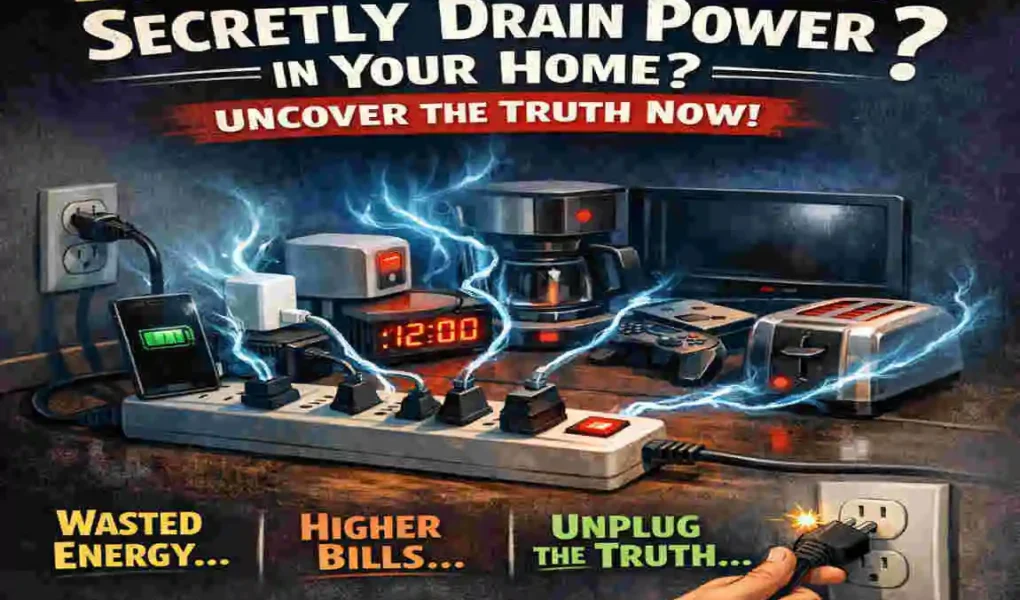
Picture this familiar scenario: It is late at night. You have just finished binge-watching your favorite television series. You press the power button on your remote control, the screen fades to black, and you flip off the living room light switch. As you head up the stairs to bed, your house is completely silent. But is it truly asleep?
Downstairs in the shadows, your television is still listening for the next command from your remote. Your microwave clock is glowing brightly, counting down the minutes. Your smartphone charger, left dangling from the wall outlet without a phone attached, is quietly sipping power. If you are reading this and wondering, do appliances plugged in use electricity even when they are technically turned off? The short, somewhat surprising answer is an absolute yes.
This silent, invisible phenomenon is known by a few spooky names: vampire energy, phantom power, or standby power drain. While it might seem completely harmless that your coffee maker has a glowing red light, this constant trickle of power is silently inflating your monthly utility bills. In fact, energy experts estimate that this home energy waste accounts for a significant chunk of your annual electricity costs. For the average household, this hidden power drain can easily cost you an extra $100 to $200 every single year.
Imagine what you could do with an extra two hundred dollars in your pocket right now. That is a nice family dinner out, a contribution to your holiday fund, or a chunk of your grocery bill, all currently being wasted on appliances you are not even actively using.
What Is Phantom Energy?
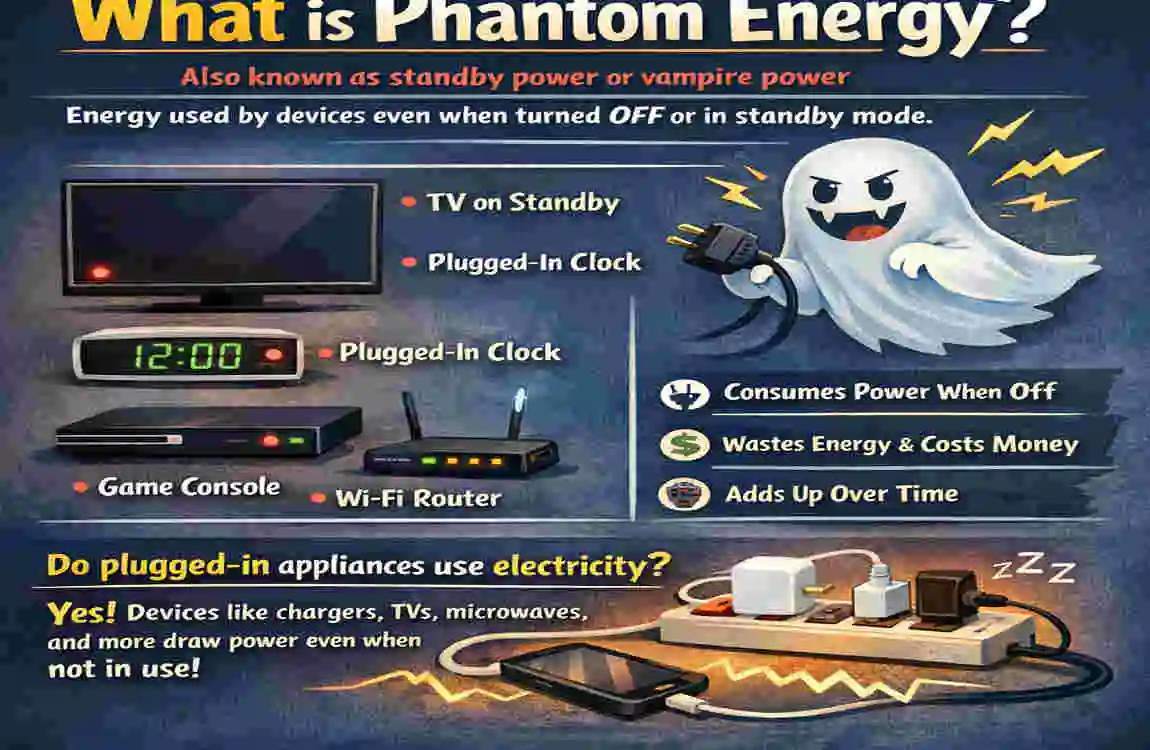
To truly conquer your utility bill, you first need to understand your invisible enemy. What exactly is phantom energy, and why does it exist in the first place?
Phantom energy, also known as standby power or vampire power, is the electricity drawn by plugged-in devices when they are in their “off” or “standby” Mode. Pressing the power button completely severs the electrical connection, just as flipping a traditional light switch does. However, modern technology is much more complicated than that.
Today, we demand instant convenience from our devices. We want our televisions to turn on the exact millisecond we press the remote. We want our smart speakers to answer us the moment we call their name. We want our gaming consoles to download massive software updates while we sleep so that we can play the next day. To provide this modern convenience, these devices can never truly go to sleep. They must remain in a state of constant readiness, and maintaining that readiness requires a continuous flow of electricity.
So, yes, appliances plugged in use electricity via transformers and internal digital clocks. Let’s break down the science behind this. Take a look at the power cords for your laptop, Wi-Fi router, or video game console. You will likely notice a heavy, rectangular black box attached to the cable, or a bulky plug that goes directly into the wall. These are called power adapters or transformers.
Your home’s electrical outlets provide Alternating Current (AC) power. Still, most of your electronic devices require Direct Current (DC) power to operate safely. The job of that bulky transformer is to convert the AC power into DC power. Here is the catch: as long as that transformer is plugged into the wall, it continues to draw power and perform that conversion, even if the device on the other end is completely detached or powered down. This is scientifically known as “no-load power.” If you have ever touched a laptop charger that is plugged into the wall but not connected to a laptop, you might have noticed it feels warm. That heat is literal energy being wasted!
The scale of this issue is surprisingly massive. According to energy conservation agencies, standby power drain accounts for a staggering 5% to 10% of total residential energy use in the United States. That means for every ten dollars you spend on electricity, one entire dollar is paying for appliances doing absolutely nothing but sitting in the dark, waiting for you to use them.
Common Culprits in Your Home
Now that you understand the science behind vampire energy, it is time to go on a hunt through your house. You might be surprised to learn that not every appliance is a vampire. Your older, standard toaster with a physical push-down lever? When it is off, it is truly off. Your basic bedside lamp with a physical switch? Completely off.
The real culprits are devices with digital displays, remote controls, continuous internet connections, and internal timers. These plugged-in appliances use electricity quietly, 24 hours a day, 7 days a week.
Let’s look at a breakdown of the top offenders hiding in plain sight. Below is a table highlighting the estimated standby wattage and the average annual cost of keeping these devices plugged in (assuming an average electricity rate of $0.15 per kilowatt-hour).
ApplianceStandby WattsAnnual CostNotes
TV / Cable Box 20-50W $20-$50 DVRs are the absolute worst offenders.
Game Console 10-30W $10-$30 Xbox/PS5 resting in “Instant-On” Mode.
Phone Charger 0.5-5W $5-$10 Draws power even without a phone attached.
Microwave 2-5W $5-$10 The digital clock display never sleeps.
Coffee Maker 5-10W $10-$20. Internal programmable timers keep it alive.
Refrigerator 1-3W $3-$5 Modern smart compressors and digital panels.
Printer/Scanner 5-15W $10-$25 “Wake-on-LAN” features keep Wi-Fi active.
Smart Speakers 2-5W $5-$10 Always actively listening for a wake word.
Let’s take a closer look at a few of these notorious energy vampires:
The Entertainment Center: Your living room is likely the biggest drain in your entire house. Your television is sitting there waiting for the infrared signal from your remote. Meanwhile, your cable box or DVR is working overtime. Even when you are not watching TV, a DVR is constantly communicating with the cable provider, updating programming guides, and spinning its internal hard drive to record your scheduled shows.
Gaming Consoles: Modern gaming consoles like the PlayStation 5 and Xbox Series X are incredible pieces of technology, but they are also massive energy hogs. By default, many of these systems are set to “Rest Mode” or “Instant-On” Mode. This allows you to turn them on with a controller and download updates in the background. However, this feature keeps the console’s internal network card and processors partially active, draining significant wattage around the clock.
The Kitchen Counters: Walk into your kitchen and count the glowing lights. Your microwave clock, your coffee maker’s programmable timer, and your smart oven’s display panel are all constantly pulling small amounts of juice. While a microwave only uses a few watts to power its clock, remember that it runs for 8,760 hours a year!
The Home Office: Printers are a classic example of phantom energy. If you own a modern wireless printer, it maintains a constant connection to your home Wi-Fi network so you can print from your smartphone at a moment’s notice. This “Wake-on-LAN” feature ensures the printer’s internal computer never actually turns off.
A great tip to start mitigating this issue immediately is to group these culprits. Try plugging your entire computer setup (monitor, printer, speakers) or your whole entertainment center into a single, high-quality power strip. When you are done for the day, flip the one switch on the power strip to cut off the vampire drain entirely.
How Much Power Do They Really Drain?
It is easy to look at a phone charger drawing a measly 2 watts and think, “Who cares? That is nothing.” But vampire power is a game of slow and steady accumulation. To really grasp the impact of home energy waste, we need to do some simple math. Do not worry; you don’t need to be an engineer to figure this out!
Determining whether and how appliances plugged in use electricity comes down to a very basic formula. Electricity is billed by the Kilowatt-Hour (kWh). To figure out how much an appliance costs you over a year, you need to calculate its total kWh usage.
Here is the simple formula: (Standby Watts × 24 hours × 365 days) ÷ 1000 = Total kWh per year.
Let’s put this formula into practice with a real-world example. Imagine you have a slightly older television and a cable box, both of which draw 30 watts of standby power while sitting in your living room.
- First, multiply 30 watts by 24 hours in a day. That gives you 720 watt-hours per day.
- Next, multiply 720 watt-hours by 365 days in a year. That equals 262,800 watt-hours per year.
- Finally, divide that massive number by 1000 to convert it into Kilowatt-Hours. You are left with 262.8 kWh per year.
Now, look at your monthly utility bill. The average cost of electricity in the United States is around $0.15 per kWh (though this varies wildly depending on where you live). If you multiply 262.8 kWh by $0.15, you get $39.42.
That is nearly forty dollars a year spent on just one television setup doing absolutely nothing! Now multiply that by the three TVs in your house, and add in the gaming consoles, microwaves, and chargers. You can quickly see how an average home can easily waste between 200 and 400 kWh of energy every year.
It is important to note the difference between old and new appliances here. Technology has improved drastically over the last decade. If you have an ancient plasma TV from 2008 in your basement, it is likely sucking down far more phantom power than a brand-new LED TV. Modern regulations and certifications, like the ENERGY STAR program, have forced manufacturers to become more efficient. In fact, replacing an old appliance with an ENERGY STAR certified model can often cut your standby power consumption by up to 50%.
However, while individual modern devices are more efficient, we are bringing far more devices into our homes than ever before. For every watt we save on a new TV, we lose it by plugging in three new smart speakers and a robotic vacuum cleaner.
Myths vs. Facts
When it comes to home electricity, there is a lot of misinformation floating around. You have probably heard advice from your parents or neighbors that may not be entirely accurate. Let’s take a moment to debunk some of the most common myths surrounding phantom energy.
If an appliance is turned “off,” it is not using any power.
The Fact: As we have explored, this is the biggest misconception of all. Standby power is incredibly real. For some modern appliances, up to 75% of the electricity they consume over their lifetimes is used while they are technically off! Devices that use remote controls, maintain internet connections, or have digital displays are never truly powered down unless you physically pull the plug from the wall.
The only way to save money is to unplug every single cord in my house every day, physically.
The Fact: Nobody wants to crawl under their dusty TV stand every single night to unplug cords. While unplugging works perfectly, it is definitely not hassle-free, and doing it constantly can even wear out the physical electrical outlets over time. The key is to prioritize high-drain items. Leave your refrigerator and Wi-Fi router alone, but focus on the entertainment center and the guest room electronics that are rarely used. Using smart technology, such as power strips, makes this process seamless.
If an appliance has a tiny LED indicator light, it doesn’t use enough power to matter.
The Fact: An actual LED bulb indeed requires almost zero energy to illuminate. However, the LED itself is not the problem. The problem is the internal transformer that steps down your wall’s 120-volt AC power to the tiny 5-volt DC needed to light that LED. Any plugged-in transformer draws juice continuously. The glowing light is simply the visual evidence that the transformer is actively consuming your electricity.
By understanding the truth behind these myths, you can stop stressing over the wrong things and start focusing on the actionable steps that will actually lower your utility bill.
Cost Impact on Your Wallet
We have touched on the math, but let’s really put the financial truth of appliances plugged into the grid into perspective. The money you are losing to vampire power is essentially a hidden tax on your household—a tax you are paying voluntarily simply by leaving things plugged in.
At the national level in the United States, the Department of Energy estimates that the average household loses between $100 and $175 per year to phantom power. Across all American households, this amounts to over $19 billion in wasted electricity annually. That is a staggering amount of money vanishing into thin air, alongside millions of tons of unnecessary greenhouse gas emissions from power plants.
However, these costs can fluctuate wildly depending on where you live. Electricity rates are highly regional. If you live in a state like Hawaii or California, where electricity prices are significantly higher than the national average, your vampire power costs could easily exceed $250 a year.
Let’s look at an international example for perspective. In countries experiencing rapid inflation and high energy costs, the impact is felt even more severely. For instance, in Pakistan, electricity rates can range from PKR 20 to PKR 30 per unit (kWh), depending on usage tiers and taxes. In such economies, a wasted 300 kWh a year translates to thousands of Rupees lost—money that is critical for essential daily living expenses.
Let’s look at a realistic savings scenario for your own home. Imagine you decide to tackle just five devices today. You unplug your spare bedroom TV, put your primary entertainment center on a switchable power strip, change your gaming console from “Instant-On” to “Energy Saver” Mode, unplug your guest bathroom electric toothbrush charger, and unplug your laptop charger when not in use.
By making just these five minor adjustments, you could effortlessly shave $50 to $75 off your annual utility bill.
Think of it as giving yourself a free, effortless financial bonus every single year, just for changing a few simple habits.
Simple Ways to Stop the Drain
You know the culprits and the costs. Now it is time to take action. Stopping phantom energy does not require you to live in the dark ages or sacrifice your modern conveniences. Here is a simple, step-by-step guide to solutions for appliances that use electricity when plugged in.
Audit Your Home with an Energy Monitor
Don’t guess which appliances are draining power—find out for sure! You can purchase a simple plug-in energy monitor (like a Kill-A-Watt meter) online for about $20. You plug the monitor directly into your wall outlet, and then plug your appliance into the monitor. It will display exactly how many watts the device is drawing in real time. Spend a Saturday walking around your house testing devices while they are turned “off.” You will instantly identify your biggest household vampires.
Utilize Smart Power Strips
This is the ultimate secret weapon against vampire power. A standard power strip gives you more outlets. Still, a smart power strip (or advanced power strip) actively manages your electricity. These strips feature outlets for a master and an enslaved person. For example, you plug your TV into the “Master” outlet, and your soundbar, DVD player, and game console into the “Slave” outlets. When you turn off the TV, the smart strip senses the power drop and automatically cuts power to all the slave outlets. It automatically kills the vampire drain for your whole entertainment center!
Upgrade to ENERGY STAR Appliances
You shouldn’t throw away a perfectly good appliance to save a few watts of standby power. However, when it is time to replace an old television, computer, or refrigerator, always look for the blue ENERGY STAR label. These certified devices are rigorously tested and must meet strict standby power limitations, ensuring they won’t act like massive energy vampires in your home.
Unplug Chargers Post-Use
Make it a daily habit to unplug battery chargers as soon as the device reaches 100%. This includes your smartphone, tablet, laptop, power tools, and electric toothbrushes. If the charger feels warm to the touch when nothing is attached, it is a waste of your money. Pull it out of the wall or plug it into a power strip you can easily switch off.
Leverage Smart Plugs
If an outlet is hard to reach—like the one buried behind your heavy living room sofa—plug a Wi-Fi-enabled smart plug into the wall first. You can then plug your lamp or device into the smart plug. This allows you to completely sever the electrical connection using an app on your smartphone, eliminating the standby drain without ever having to move your furniture.
Advanced Tips for Tech-Savvy Homes
If you are a technology enthusiast or you already have a smart home ecosystem set up, you can take your fight against phantom power to the absolute next level.
Smart Home Routines: If you use platforms like Amazon Alexa, Google Home, or Apple HomeKit, you can automate your energy savings. Group all your smart plugs together in the app and create a routine called “Goodnight.” When you say, “Alexa, goodnight,” the system will automatically cut power to your entertainment center, home office setup, and kitchen countertop appliances. You can even set this routine to trigger automatically when your phone’s GPS location indicates you’ve left the house for work.
Solar Tie-Ins for Offsets: If you are investing in residential solar panels, you might think phantom power doesn’t matter anymore because your energy is “free.” However, vampire energy drains your battery storage at night! By minimizing your standby load, you ensure your expensive solar batteries last completely through the night, reducing your reliance on the grid during early morning hours.
Long-Term Strategy: Consider a comprehensive whole-home energy audit. Professional auditors can use thermal imaging and advanced electrical tracking at your breaker box to find hidden drains you might never notice, giving you a complete blueprint of your home’s energy health.
Real-Home Case Studies
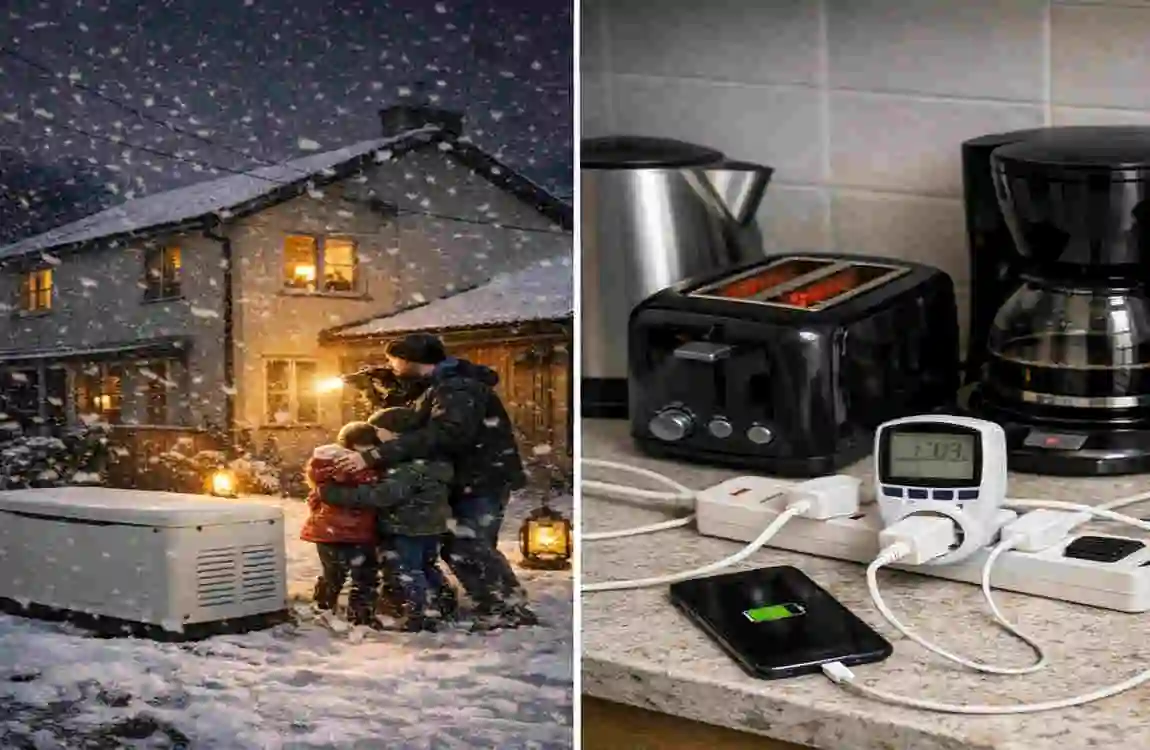
Sometimes, the best way to understand the impact of these changes is to look at real-world examples.
The Johnson Family’s Kitchen Audit: A family of four living in a suburban home decided to test their kitchen appliances after noticing their energy bills creeping up. They discovered that their coffee maker, microwave, and a constantly plugged-in secondary chest freezer (which was mostly empty) were drawing a combined 40 watts of phantom power. By putting the coffee maker on a smart plug, ignoring the microwave clock, and consolidating their food to unplug the freezer when it’s empty, they immediately cut their energy waste, saving an estimated $120 over the following year.
Alex the Gamer: Alex is a heavy PC and console gamer. His desk setup included two monitors, Premium speakers, a high-end PC, and a PlayStation 5 left in rest Mode. An energy monitor revealed his desk was pulling a massive 65 watts while he was at work. Alex invested in a $30 advanced smart power strip. By using his PC as the master control, everything else completely shuts down when he powers off his computer. Alex successfully cut his tech setup’s standby power consumption by 80%, paying off the cost of the smart strip in just 4 months.
FAQ Section
Do appliances plugged in use electricity when off? Yes, they do. Many modern appliances enter a “standby” Mode rather than fully turning off. Devices with remote controls, digital clocks, or Wi-Fi connections continuously draw between 1 and 50 watts of standby power to remain ready for instant use.
What are the top vampire appliances in a home? The biggest culprits are usually found in your entertainment center. Televisions, cable boxes, DVRs, and gaming consoles draw the most phantom power. Other common offenders include microwaves, coffee makers with timers, computers, and phone chargers.
How can I measure standby power drain? The easiest and most accurate method is to use a plug-in electricity usage monitor, such as a Kill-A-Watt meter. You plug the meter into your wall outlet, and then plug your appliance into the meter. It will provide a real-time digital readout of the exact wattage the device consumes while off.
Should I unplug my appliances every night? While unplugging everything would technically save the most energy, it is impractical. Instead, use smart power strips for your high-drain areas like your TV and computer setups. Leave essential items, such as your Wi-Fi router and refrigerator, plugged in at all times.
Do phone chargers use electricity when not plugged into a phone? Yes. The transformer inside the charger continues to convert AC power from the wall into DC power, even if a device is not attached. While the drain is small (usually less than 1 watt), leaving multiple chargers plugged in year-round will slowly add to your utility bill.