

Have you ever found yourself standing in the middle of your kitchen, holding a piece of raw chicken in both hands, staring desperately at your sink? You need to wash your hands, but you know that touching the faucet handle will spread dangerous bacteria everywhere. We have all been there. It is a frustrating, messy reality of daily cooking. But what if you never had to touch your kitchen faucet again?
Welcome to the future of home design. In 2026, the heart of the home has experienced a massive technological upgrade. We are no longer just looking at smart refrigerators or automated coffee makers. The biggest game-changer making waves in modern homes is the smart kitchen faucet.
You might be asking yourself, ” What is a smart kitchen faucet? In simple terms, it is a brilliant, hands-free upgrade that brings ultimate convenience right to your kitchen sink. By utilizing advanced motion sensors, highly responsive voice control, and smart home connectivity, these fixtures are completely changing how we cook, clean, and interact with water.
Beyond just the “cool factor” of talking to your sink, these devices offer immense practical value. They are incredibly hygienic, they make multitasking a breeze, and they are champions of water conservation. In a world where sustainability is more important than ever, these smart fixtures can drastically reduce your monthly water bills.
| Aspect | Description |
|---|---|
| Core Definition | Electronic faucet with motion, touch, or voice activation to control water flow without touching handles. |
| Key Technologies | Infrared sensors for waving hands; capacitive touch on spout; voice integration (Alexa/Google). |
| Main Features | Temperature presets, timers, low-flow rates, app alerts for leaks, pull-down sprayers. |
| Top Benefits | Hygiene (less bacteria), water savings (30-50%), convenience for cooking/cleaning. |
| Power Source | Batteries or AC adapter under sink; lasts 1-2 years per set. |
| Average Cost | $300-$600, with ROI from efficiency. |
What Is a Smart Kitchen Faucet?
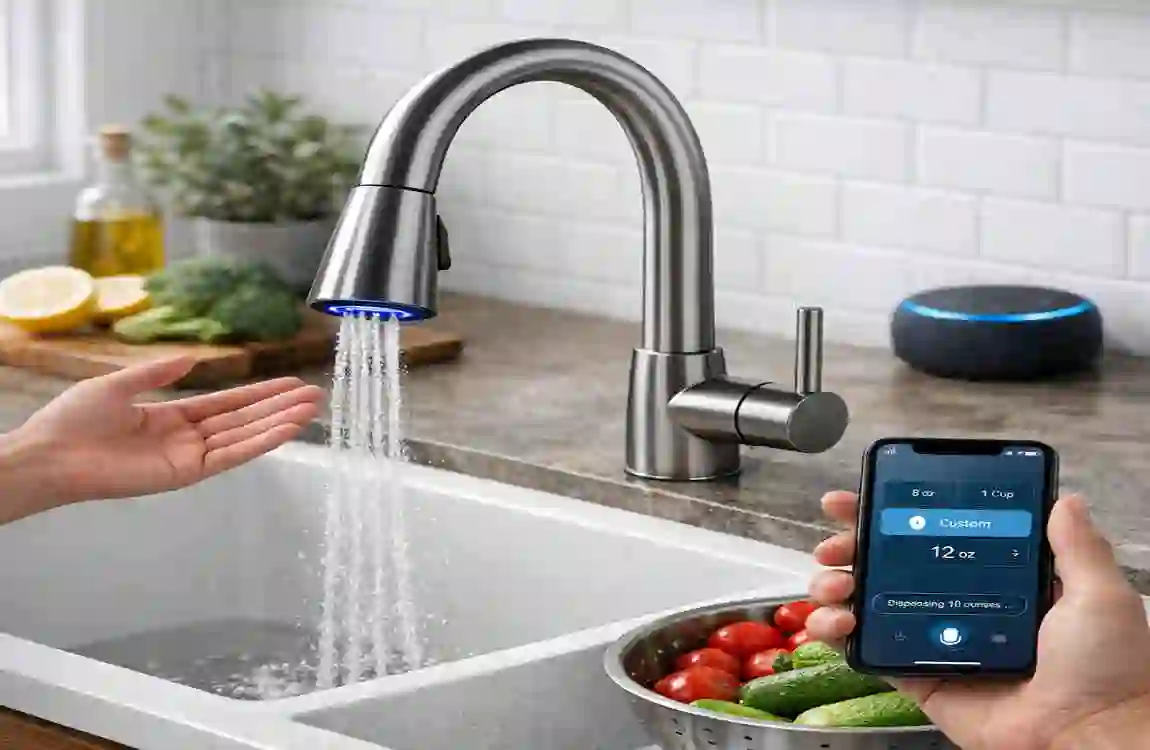
Let us start with the basics. A smart kitchen faucet is a highly advanced, automated plumbing fixture that allows you to turn your water on and off without ever needing to pull, push, or twist a traditional handle.
Instead of relying on physical force, these modern marvels use cutting-edge sensors and wireless technology to operate. While they still feature a manual handle for backup use or manual temperature adjustments, their primary draw is their touchless operation. You wave a hand, tap the spout, or speak a command, and the water flows instantly.
The Evolution from Basic to Brilliant
To truly appreciate these devices, it helps to understand how much they have evolved. Just a decade ago, touchless faucets were mostly found in public restrooms. They were clunky, often unresponsive, and frankly, a little annoying. You would wave your hands frantically under the spout, hoping the water would finally come out.
Today, the technology has taken a quantum leap forward. The smart kitchen faucets of 2026 are highly sensitive, incredibly accurate, and beautifully designed. They are no longer just commercial fixtures; they are elegant centerpieces for luxury home kitchens. They have evolved from basic infrared motion detectors to fully integrated smart home appliances that you can control right from an app on your smartphone.
The Three Main Types of Smart Faucets
When you shop for a smart faucet today, you will generally encounter three distinct types of technology.
Motion-Activated Faucets: These are the most common types. They feature a tiny, invisible sensor—usually located at the base or the neck of the faucet. When you swipe your hand across the sensor’s field of vision, the water turns on. Swipe again, and it turns off. It is essentially magic disguised as plumbing.
Touch-Sensitive Faucets: If you prefer a more tactile experience, touch-sensitive models are incredible. Instead of waving your hand, you tap any part of the faucet spout or handle with your wrist, forearm, or the back of your hand. This is an absolute lifesaver when your fingers are coated in bread dough or meat juices.
Voice-Integrated Faucets. This is where things get truly futuristic. Voice-integrated faucets connect directly to your home’s Wi-Fi network and communicate with digital assistants like Amazon Alexa, Google Assistant, or Apple Siri. You can literally stand across the room and say, “Turn on the kitchen sink,” or “Pour exactly one cup of water,” and the faucet will obey.
Leaving Traditional Faucets in the Past
When you contrast a smart faucet with a traditional one, the differences are night and day. Traditional manual faucets are magnets for grime, fingerprints, and bacteria. Every time you touch them with dirty hands, you leave a mess behind that you eventually have to clean up.
For busy households, chaotic family dinners, and enthusiastic home chefs, the smart faucet offers unparalleled hygiene and convenience. It speeds up your prep time, keeps your cleaning to a minimum, and adds a touch of modern luxury to your everyday routine.
How Smart Kitchen Faucets Work
You might be wondering how a piece of metal pushing water can suddenly understand your voice or sense your presence. It sounds complicated, but the underlying science is actually quite straightforward and fascinating. Let’s break down the complex technology into understandable, bite-sized pieces.
The Magic of Infrared Sensors
If you opt for a motion-activated faucet, the star of the show is the infrared sensor. Think of this sensor as a tiny, invisible flashlight built right into the metal body of the faucet.
This sensor constantly emits an invisible infrared beam into the space directly in front of or below the sink. When your hand, a dirty pot, or a sponge enters that space, the invisible light hits the object and bounces right back into the sensor’s receiver.
Once the receiver catches that bounced light, it instantly sends an electrical signal to a small valve hidden inside the faucet base. This valve, known as a solenoid valve, snaps open, allowing water to rush through the pipes and out of the spout. When you wave your hand again, the signal reverses, the valve snaps shut, and the water stops instantly. It all happens in a fraction of a second.
The Science of Capacitive Touch
Touch-sensitive faucets use a completely different method called capacitive sensing. This is the same technology that allows the touchscreen on your smartphone or tablet to recognize your finger.
Your body naturally carries a very small, harmless electrical charge. The metal body of a touch-sensitive faucet is hooked up to a sensor that establishes a baseline electrical field. When your skin comes into contact with the metal spout, your body’s natural electrical field disrupts that field. The faucet’s computer brain registers this tiny disruption as a “tap” and commands the internal valve to open or close.
The Brilliance of Voice Control
Voice-controlled faucets are tiny computers hooked up to your plumbing. Inside the control box (usually mounted under your sink), there is a Wi-Fi chip. This chip connects the faucet to your home’s internet router, which in turn connects to your smart speakers.
When you ask your digital assistant to “pour two cups of water,” the assistant translates your voice into digital code, sends it through the cloud, down to your home router, and straight into the faucet’s brain. The faucet then uses an internal digital flow meter to measure exactly 2 cups of water before automatically shutting off the valve.
Powering the Brain: Batteries vs. AC Power
Because these faucets rely on sensors, Wi-Fi chips, and motorized valves, they need electricity to function. You generally have two choices when it comes to powering your new device.
Battery Power: Many smart faucets use standard AA or D-cell batteries housed in a waterproof pack under the sink. This is highly convenient because it requires no complex electrical work to install. A fresh set of batteries will typically last you 1 to 2 years, depending on how often you cook.
AC Adapter: If you have an electrical outlet under your sink (often used for garbage disposals), you can plug the faucet directly into the wall. This means you never have to worry about changing batteries, providing a continuous, reliable power source.
Built-In Safety Timers
One common fear people have is, “What if the cat walks by the sensor and turns the water on while I am at work?” Manufacturers have already thought of this. Every smart faucet comes with an automatic shut-off timer to prevent accidental overflows. If the water runs continuously for a set period—usually 3 to 5 minutes—the internal valve will automatically slam shut, preventing a disastrous flood in your home.
Key Features of Smart Faucets
As we navigate through 2026, the features packed into these devices have become incredibly robust. They are no longer just about turning water on and off. Let’s explore the top features that make these fixtures a must-have for modern kitchens.
True Hands-Free Activation
This is the core feature that draws most people in. Whether it is via an infrared wave or a gentle tap on the forearm, hands-free activation is a game-changer. It means you can tackle messy kitchen tasks—like mixing meatloaf, breading chicken, or repotting house plants—without ever transferring that mess onto your beautiful plumbing fixtures.
Precision Temperature Presets
Have you ever struggled to find the perfect water temperature for washing dishes or mixing baby formula? Advanced smart faucets now feature digital temperature presets.
Through voice commands or a connected smartphone app, you can command the faucet to dispense water at exactly 98 degrees Fahrenheit. The faucet will automatically mix the hot and cold water lines under the sink to achieve your desired temperature, perfectly every time. No more scalding your hands or waiting endlessly for the water to warm up.
Water Flow Monitoring and Tracking
Knowledge is power, especially when it comes to your utility bills. Many modern smart faucets act as highly accurate water meters. They track exactly how many gallons of water you use each day, week, and month.
You can open up the companion app on your phone and see a detailed breakdown of your household’s water consumption. This visibility is an amazing tool for eco-conscious families who want to set conservation goals and reduce their environmental footprint.
Magnetic Pull-Down Sprayers
Just because a faucet is “smart” doesn’t mean it lacks traditional utility. Almost all premium smart faucets feature sleek, integrated pull-down spray heads. These hoses reach deep into your sink to blast away food debris from your largest pots and pans. Once you let go, powerful magnets seamlessly snap the spray head back into its docking station.
App Notifications and Leak Detection
This feature alone is worth the price of admission. By 2026, smart faucets will be equipped with highly sensitive leak-detection technology. If the system senses a pressure drop or unusual, continuous trickling beneath the sink, it will immediately send an emergency push notification right to your smartphone. Catching a small leak early can save you thousands of dollars in water damage and mold remediation costs.
The Innovation: AI Adjustments
The latest trend hitting the market right now is Artificial Intelligence integration. High-end models are beginning to learn your household’s daily routines. For example, the AI might notice that every morning at 7:00 AM you use cold water to fill the coffee pot, but at 6:00 PM you use hot water to do the dishes. The faucet will begin to pre-emptively adjust the internal mixing valves based on the time of day, saving you time and giving you a truly personalized kitchen experience.
Feature Comparison Across Control Types
To help you visualize how different styles stack up against each other, take a look at this helpful comparison table:
Feature Capability Motion Sensor Models Voice Controlled Models App Integrated Models
Hygiene Boost High (Zero physical contact) Medium (Requires voice setup) Low (App is for tracking)
Water Savings 30-50% (Quick shut-offs) Variable (Depends on usage) High (Data helps reduce waste)
Ease of Use Very High (Intuitive waves) Medium (Requires specific phrases) Medium (Requires smartphone)
Mess Prevention Excellent Excellent N/A
Benefits for Your Home
Upgrading to a smart kitchen faucet is not just an aesthetic choice; it is a functional lifestyle upgrade. The benefits ripple out, positively impacting your health, daily routine, and wallet. Let us dive into why you absolutely need one of these in your home.
Unmatched Hygiene and Cleanliness
Your kitchen sink is arguably the most heavily used workstation in your entire house. It is also a notorious breeding ground for bacteria. Think about it: you handle raw meat, dirty vegetables, and pet food, and then you immediately grab the faucet handle. Later, someone else grabs that same handle to get a glass of drinking water.
A smart faucet acts as an invisible shield against cross-contamination. By eliminating the need to touch the hardware physically, you drastically reduce the spread of harmful bacteria such as Salmonella and E. coli throughout your kitchen. Your sink stays cleaner, your family stays healthier, and you spend significantly less time scrubbing smudges off your fixtures.
Ultimate Multi-Tasking Convenience
Cooking is a chaotic dance. You are often trying to chop vegetables, stir a boiling pot, and clean up spills all at the same time.
Imagine you are holding a heavy, boiling pot of pasta water with both hands. With a traditional sink, you have to set the heavy, hot pot down awkwardly, turn on the cold water, then pick it back up to drain it. With a smart faucet, you wave your elbow past the sensor as you approach the sink, and the water turns on instantly. It feels like having a helpful sous-chef standing right next to you, ready to assist whenever your hands are full.
Incredible Water Efficiency and Sustainability
Did you know that the average family wastes hundreds of gallons of water every year simply by leaving the tap running? At the same time, they scrub dishes or wash their hands. We turn the water on, step away to grab the soap, scrub our hands, and then rinse. The whole time, clean, usable water is literally pouring down the drain.
Smart faucets eliminate this waste. Because it is so effortless to turn the water on and off with a simple wave, you naturally stop the flow in between tasks. Furthermore, if you use a voice command to dispense exactly two cups of water for a recipe, you eliminate overpouring that occurs with a traditional measuring cup.
Studies show that households using smart faucet technology can reduce kitchen water usage by 30% to 50%. Over the course of a year, that massive reduction in water waste translates to a significantly lower utility bill, keeping more money in your pocket while protecting our planet’s most precious resource.
Top Smart Kitchen Faucets
The market is flooded with options, but not all smart faucets are created equal. You want a fixture that is incredibly durable, highly responsive, and beautifully designed to match your kitchen’s aesthetic. Here is a curated review of the top-performing models dominating the market in 2026.
The Kohler Response Touchless Series
Kohler has long been a titan in the plumbing industry, and their Response technology is phenomenal. This faucet features a highly accurate infrared sensor, hidden seamlessly beneath the spout’s curve. The response time is measured in milliseconds—it is blazing fast. It runs on AC power, features a powerful magnetic spray head, and boasts a beautifully sleek, modern design that fits perfectly in contemporary kitchens.
The Delta VoiceIQ Technology Line
If you want to feel like you live on a spaceship, the Delta VoiceIQ is for you. This faucet links flawlessly with your Amazon Alexa or Google Assistant. You can ask it to turn on, turn off, warm up, or dispense incredibly specific measurements like “three tablespoons” or “one liter.” It also features Delta’s famous Touch2O technology, letting you tap anywhere on the spout if you don’t want to talk. It is the ultimate hybrid of touch and voice control.
The Moen Smart Faucet with Motion Control
Moen has taken customization to the next level. This faucet is fully integrated with a highly rated smartphone app. Not only can you control it with your voice and motion sensors, but you can also use the app to set custom presets. For instance, you can create a preset named “Dog Bowl.” When you say, “Moen, fill the Dog Bowl,” the faucet will dispense the exact volume of water needed to fill your pet’s bowl at the perfect temperature.
The Kraus Bolden Commercial Style Touchless
For those who love the industrial, commercial-kitchen look, the Kraus Bolden is a showstopper. It features an exposed spring neck and a heavy-duty brass body. Kraus integrated an intelligent motion sensor right into the base, offering hands-free convenience without sacrificing that rugged, professional chef aesthetic. It is also one of the most budget-friendly options on the premium market.
The Brizo Artesso SmartTouch
If luxury design is your top priority, Brizo delivers. The Artesso line is inspired by early 1900s industrial design but packed with 2026 technology. It features hidden capacitive touch sensors and an LED light at the base that changes color to indicate the water’s temperature visually. It is a stunning piece of functional art for high-end kitchen remodels.
Comparison of the Top Models
Model Name Average Price Primary Sensor Type Customer Rating Best Feature
Kohler Response $450 Infrared Touchless 4.8 / 5 Blazing fast response time
Delta VoiceIQ $550 Voice & Touch 4.7 / 5 Exact custom measurements
Moen Smart $600 Voice, Motion & App 4.9 / 5 Deep app integration & presets
Kraus Bolden $300 Infrared Touchless 4.6 / 5 Commercial aesthetic at a value
Brizo Artesso $800 Capacitive Touch 4.8 / 5 Unmatched luxury design
Installation Guide: Bringing Smart Tech to Your Sink
You have picked out the perfect faucet, and now it is sitting in a box on your kitchen counter. You may feel intimidated. It has wires, a battery box, and confusing-looking hoses. Don’t panic! Installing a smart kitchen faucet is much easier than you think.
DIY vs. Professional Installation
For the average handy homeowner, this is absolutely a DIY project. If you have ever replaced a standard faucet, you already have 90% of the required knowledge. The entire process generally takes between 30 and 60 minutes.
However, if your under-sink plumbing is ancient, heavily corroded, or if you hate crawling around in tight spaces, hiring a professional plumber is always a safe bet. A pro can easily install and calibrate this in under an hour.
Tools You Will Need
Gather your supplies before you start. You will need:
- An adjustable wrench.
- A basin wrench (extremely helpful for reaching tight nuts behind the sink).
- Use plumber’s tape (Teflon tape) to prevent leaks.
- A bright flashlight or headlamp.
- A small bucket and an old towel to catch drips.
Step-by-Step Installation Process
Shut Off the Water. This is crucial! Climb under your sink and locate the hot and cold water supply valves. Turn them completely clockwise until they are tight. Turn on your old faucet to release any remaining pressure and verify the water is actually off.
Remove the Old Faucet. Use your wrench to disconnect the hot and cold water lines from the wall valves. Then, use your basin wrench to unscrew the mounting nut holding the old faucet to the sink deck. Pull the old faucet straight up and out. Take a moment to thoroughly clean the sink deck.
Drop in the New Smart Faucet. Feed the new hoses and the data cables of your smart faucet down through the hole in your sink. Slide the new mounting bracket and nut up from underneath and tighten them securely so the faucet body doesn’t wiggle.
Connect the Control Box. This is where it gets “smart.” Mount the digital control box to the wall or cabinet side under your sink. Connect the faucet’s water hoses to this control box, and then connect the box to your home’s hot and cold water supply valves. Wrap the threads in plumber’s tape before tightening!
Power It Up: Connect the data cable from the faucet to the control box. Finally, insert the batteries into the battery pack (or plug in the AC adapter) and connect the box to it. You will usually hear a happy little beep letting you know the brain is awake.
Test and Calibrate. Turn the water supply valves back on. Check underneath with your flashlight for any leaks. Wave your hand in front of the sensor. If the water flows, you have successfully upgraded your kitchen!
Cost, Maintenance, and Savings
Let us talk about the financial side of this upgrade. Is a smart faucet a wise investment for your household?
The Upfront Cost
When you walk into a home improvement store, you will notice that smart faucets carry a premium price tag compared to their basic counterparts. On average, a high-quality smart kitchen faucet costs between $300 and $600. If you opt for absolute luxury brands with voice integration, you can easily push that number up to $800.
The Return on Investment (ROI)
While the initial purchase is higher, remember that this appliance actively helps you save money. By preventing water from running down the drain while you wash dishes or prep food, the average family can easily save $50 to $70 a year on water and water-heating bills.
If your faucet lasts for an expected lifespan of 8 to 10 years, the $50 annual savings completely cover the premium technology upgrade over the life of the fixture!
Simple Maintenance Requirements
Maintaining your high-tech sink is surprisingly low-effort.
- Battery Changes: If you opt for a battery-powered unit, you will need to swap out the AA batteries every 1 to 2 years. Most faucets will flash a red LED light at the base to warn you a few weeks before the batteries die, so you are never caught off guard.
- Sensor Cleaning: The sensors are essentially tiny glass windows. Over time, splashing soapy water or hard water spots can cloud the sensor, reducing its responsiveness. Wipe the sensor window gently with a soft microfiber cloth and a dab of white vinegar once a month to keep it seeing clearly.
- Filter Checks: The control box under the sink often contains a tiny mesh filter to catch sediment before it reaches the digital valve. Unscrewing this filter and rinsing it out once a year ensures maximum water pressure.
Smart Faucets vs. Traditional Faucets
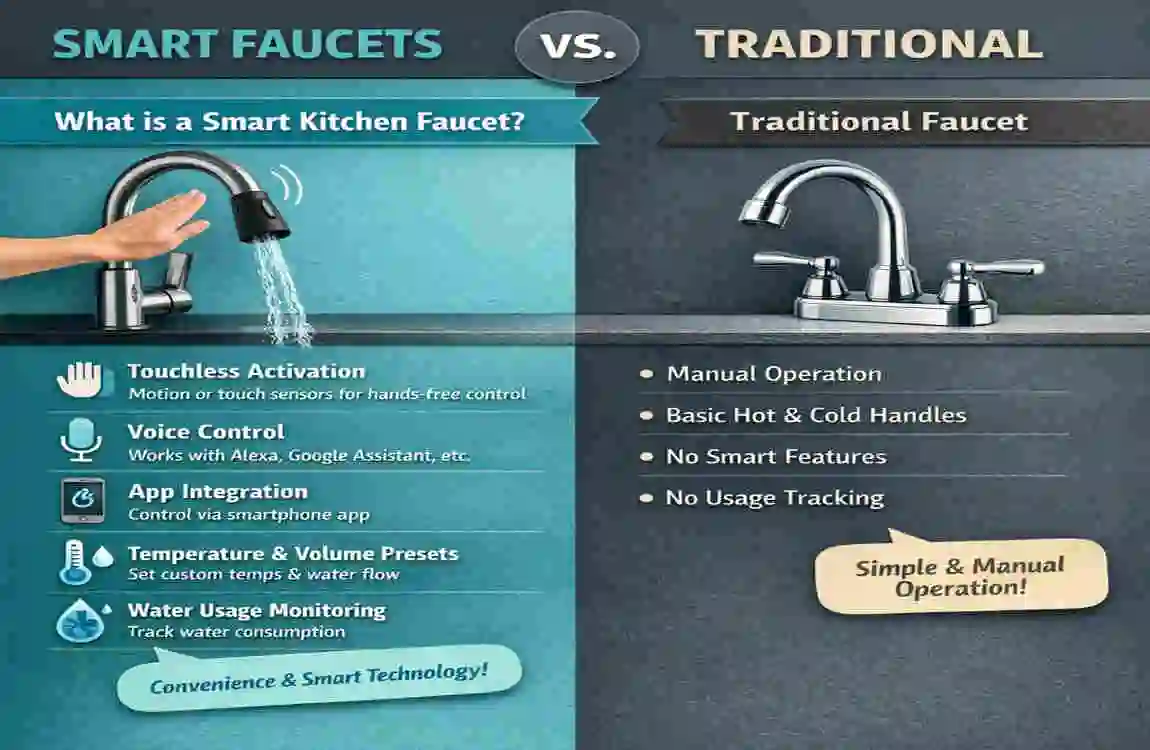
Are you still on the fence about making the jump to smart technology? Sometimes, seeing a direct comparison makes the decision much easier. Here is how the high-tech options stack up against the classic manual faucets we all grew up with.
Feature Comparison: Smart Kitchen Faucet, Traditional Manual Faucet
Hygiene & Cleanliness Superior. Zero touch required. Poor. Handles harbor harmful bacteria.
Ease of Use: Effortless multitasking. Requires free, clean hands to operate.
Upfront Cost Higher ($300 – $800+). Lower ($50-$250).
Long-Term Savings High. Reduces water waste by up to 50%. None. Relies entirely on human habits.
Installation Moderate. Requires a power and control box. Simple. Direct pipe connections.
The Verdict: The clear winner for modern upgrades. Best for strict, tight budget constraints.
While a traditional faucet will always win on the initial price tag, the smart faucet overwhelmingly wins across every category that affects your daily quality of life. For any homeowner looking to upgrade their kitchen, the smart option is the superior choice.
Frequently Asked Questions (FAQs)
As this technology becomes more popular, homeowners naturally have many questions. Let’s tackle some of the most common queries floating around in 2026.
What is the average cost of a smart kitchen faucet? For a reliable, high-quality unit from a reputable brand like Moen, Delta, or Kohler, expect to spend between $300 and $600. Budget brands exist in the $150 range, but their sensors tend to be less reliable.
How long does the battery life last? Most battery-operated smart faucets utilize 4 to 6 AA batteries. With average family use, these batteries will reliably last 12 to 24 months before needing a replacement.
What happens if the power goes out? If you have an AC-powered faucet and the power grid goes down, your sensor will not work. However, almost all smart faucets feature a manual override dial or allow you to use the physical handle as a backup, so you are never left without running water.
Can I install a smart faucet on any sink? Yes! As long as you have standard hot and cold water supply lines under your sink, a smart faucet will fit. They are designed to drop perfectly into standard single-hole or three-hole sink cutouts.
Do voice-activated faucets require a monthly subscription? No. Once you purchase the faucet, the companion app and the integration with Alexa or Google Assistant are completely free to use.