Picture this: You are standing in the middle of your current cooking space, holding a tape measure, and dreaming of a massive remodel. You want to tear down that awkward dividing wall, add a massive island for entertaining, and finally upgrade to a professional-grade stove. But as you sketch out your plans on a piece of scrap paper, a very practical question stops you in your tracks. You find yourself wondering, how big is the average kitchen in square feet in the USA?
You are certainly not alone in asking this. Every single day, homeowners embark on renovation journeys and need a baseline to plan their budgets and layouts effectively. Knowing the standard kitchen dimensions in square feet can save you from designing a space that feels too cramped for daily family life or too cavernous for efficient cooking.
So, let us get right to the numbers. Currently, the average US kitchen measures about 161 square feet in new single-family homes. However, that number is just the tip of the iceberg. Depending on the age of your house, the region you live in, and your overall floor plan, your cooking space might be significantly smaller or much larger.
| Category | Average Size (sq ft) | Notes | |
|---|---|---|---|
| National Average (New Homes) | 161 | ~13×13 ft; standard benchmark | |
| Small Homes (<1,500 sq ft) | 103 | Compact, often galley style | |
| Medium Homes (1,500-2,000 sq ft) | 120-150 | Single-story typical at 151 sq ft | |
| Large Homes (3,000-4,000 sq ft) | 191-225 | Multi-story at 174 sq ft | |
| Extra Large Homes (>4,000 sq ft) | 238-424 | Open-concept dominant | |
| With Great Room | 164 | vs. 159 without | |
| Overall US Homes (All Ages) | 150-250 | 10-15% of total home sq ft |
Current Averages: How Big is the Average Kitchen in Square Feet in the USA?
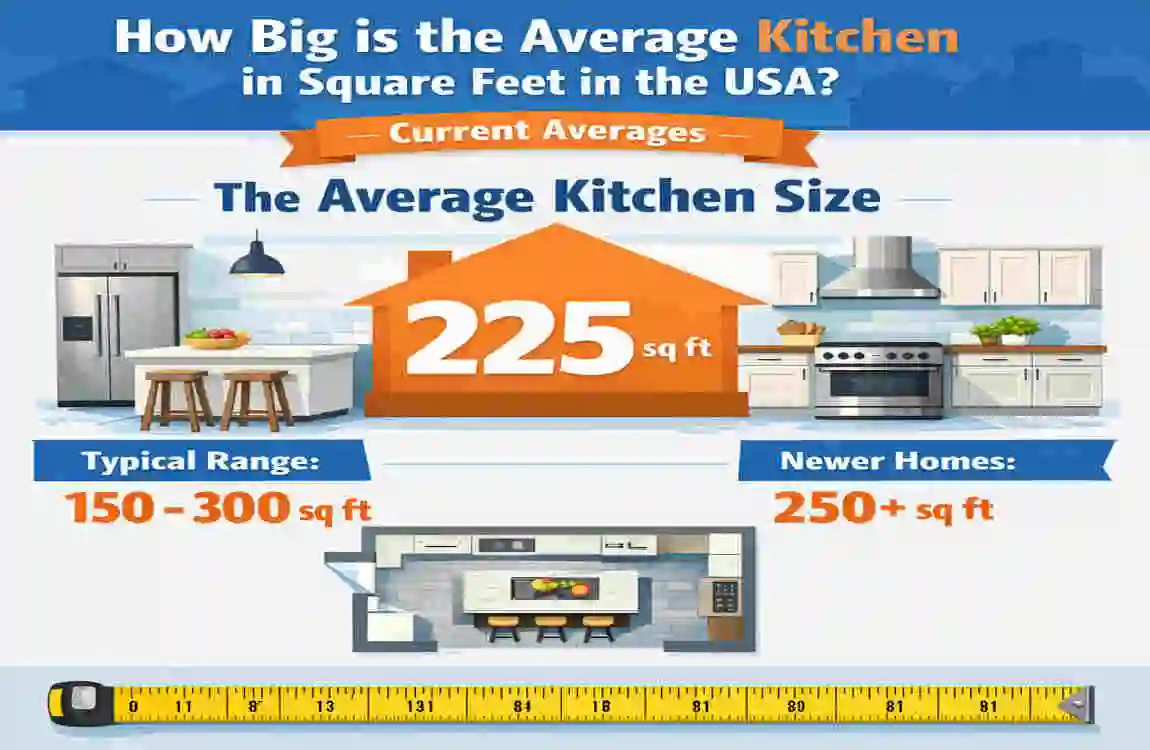
When you ask the specific question, ” How big is the average kitchen in square feet in the USA, the national average sits right at 161 square feet for newly constructed single-family homes. To help you visualise that, imagine a room roughly 10 feet wide by 16 feet long, or 12 feet by 13 feet.
This number comes directly from industry data, showing a noticeable increase compared with older homes built in the late 20th century, which typically hovered around 150 square feet. But you must remember that an “average” blends tiny starter homes with massive luxury estates.
To give you a much clearer picture, let us break down the kitchen dimensions in square feet based on the home’s overall size.
Home Size Category Average Home Sq Ft Average Kitchen (sq ft)Example Kitchen Layout
Small Homes Under 2,000 sq ft 120 – 150 sq ft Galley Kitchen / Single-Wall
Medium Homes 2,000 – 3,000 sq ft 161 – 200 sq ft L-Shaped / U-Shaped
Large Homes Over 3,000 sq ft 225+ sq ft Open-Concept Layout with Island
Why are these spaces getting larger? We experienced a massive cultural shift post-2020. People stopped going to restaurants as frequently and started baking their own bread, cooking family meals, and realising they desperately needed more counter space.
As we navigate 2026, the trend of remote work remains stronger than ever. The kitchen is no longer just a place to boil pasta. It serves as a morning coffee shop, a part-time homework station for the kids, and a casual Zoom-meeting backdrop. Because we demand so much more functionality from these rooms, we have seen a 15% to 20% increase in the average kitchen’s footprint during recent home renovations.
Key Factors Influencing Your Space
When you look at the average kitchen size in the USA, two major factors heavily influence the final number on the blueprint:
- Family Size: A single professional living alone requires far less food storage and prep area than a family of five. Larger families naturally push the average closer to the 200-square-foot mark to accommodate double ovens and massive refrigerators.
- Urban vs Suburban Locations: City living often forces builders to build “up” instead of “out.” If you live in a dense metropolitan area, your space will likely sit below the national average. If you live in a sprawling suburban neighbourhood where land is plentiful, your cooking area will easily exceed the national average.
Historical Trends in US Kitchen Sizes
To truly understand how big the average kitchen is in square feet in the USA today, you have to look at where we started. Our homes reflect our culture, and the way we use our cooking spaces has changed dramatically over the decades.
The Era of Utilitarian Efficiency
Following World War II, America saw a massive boom in suburban housing. However, the homes were modest, and the kitchens were strictly utilitarian. In the 1950s and 1960s, builders designed homes with a very specific mindset: the kitchen was a closed-off workroom, entirely separated from the dining and living areas.
During this era, a compact 100 to 120 square feet was the absolute standard. You would typically find a simple galley kitchen or a tight U-shape layout. The goal was supreme efficiency. You could stand in the middle of the room, take one step to the left to reach the stove, and one step to the right to reach the sink. Entertaining happened in the formal living room, not the kitchen.
The Birth of the Open Floor Plan
As we moved into the 1990s, the culture shifted. Cooking became less of a private chore and more of a social, family-oriented activity. We wanted to talk to our guests while we chopped vegetables. We wanted to watch the kids do their homework while we stirred the soup.
This desire gave birth to the open-concept layout. Builders started tearing down the dividing walls, and the cooking space bled naturally into the living room. Consequently, the standard dimensions expanded to around 150 square feet. We saw the introduction of the kitchen peninsula and the very early iterations of the standalone island.
The “Forever Home” Expansion
Today, we are living in the era of the “forever home.” Because moving has become so expensive, homeowners are choosing to stay put and remodel their current spaces to fit their ultimate dreams.
We are currently averaging 170 to 200 square feet in major remodelling projects. We now expect built-in coffee bars, massive walk-in pantries, and oversized islands that seat four comfortably. When comparing new builds to remodels, data shows that a major renovation in 2026 often adds 20-50 square feet to the original room footprint!
Regional Variations Across the USA
You cannot discuss the average kitchen size in the USA without considering geography. America is a massive country, and the architectural styles vary wildly from the snowy streets of Boston to the sunny beaches of San Diego.
If you ask a contractor in Manhattan, ” How big is the average kitchen in square feet in the USA, you will get a very different answer than if you ask a builder in Dallas. Here is a breakdown of how the region dictates your square footage.
The Northeast: Compact and Historic (140 – 160 sq ft)
In the Northeastern states, you face two major limiting factors: historic architecture and incredibly tight urban lots. Cities like Boston, Philadelphia, and New York feature homes that are often well over a century old.
Because space is at a premium, kitchens in this region average 140 to 160 square feet. You will see an abundance of highly efficient galley kitchen layouts that utilise vertical space, with cabinetry extending all the way to the ceiling to make up for the lack of floor space.
The South and West: Sprawling and Social (180 – 220 sq ft)
Head down to the South or over to the West Coast, and the story completely changes. Here, land is more abundant, and the modern suburban housing tracts are sprawling.
In these regions, the open-concept layout reigns supreme. The weather also plays a massive role. In warmer climates, the indoor kitchen often flows directly into an outdoor patio or an exterior summer kitchen. You will routinely see interior footprints ranging from 180 to 220 square feet, allowing for massive entertaining islands and open walkways.
The Midwest: The Balanced Middle Ground (155 – 175 sq ft)
The Midwest represents the true middle ground of American real estate. Here, you find a healthy mix of older, traditional homes and newer suburban developments. The dimensions in states like Ohio, Illinois, and Michigan balance out perfectly, usually sitting right around 155 to 175 square feet.
A Map-Style Look at Specific States
Let us look at a few specific state profiles to highlight these regional extremes:
- New York (Approx. 130 sq ft): Heavily influenced by the dense apartment living of New York City, where a “spacious” cooking area might literally be a hallway with a stove and a sink.
- California (Approx. 190 sq ft): Driven by the indoor-outdoor lifestyle. Homeowners prioritise massive sliding glass doors, natural light, and sprawling islands that transition into the living room.
- Texas (Approx. 210 sq ft): Everything is bigger in Texas, and homes are generally built with large, multi-generational family gatherings in mind. You will find massive square footage dedicated to double appliances and huge pantries.
Ultimately, the cost of living, the local climate, and overall home values dictate exactly how much of your floor plan you can dedicate to food prep.
Ideal Kitchen Sizes for Different Dream Homes
Now that we have thoroughly answered the question, ” How big is the average kitchen in square feet in the USA? “, we need to ask a more personal question: What is the ideal kitchen size for homes like yours?
You do not need to hit the national average if you live in a cosy condo, and you certainly should not restrict yourself to 161 square feet if you are building a sprawling custom estate. Let us look at the ideal dimensions based on your specific dream home.
Small Homes and Apartments (100 – 120 sq ft)
If your total home is under 1,500 square feet, a 100 to 120-square-foot cooking area is actually perfect. In these smaller spaces, efficiency is your best friend.
You want to avoid dead space where you are just taking empty steps. You can maximise this footprint by using a galley kitchen design or a tight single-wall layout. To make the room feel larger, focus on vertical storage. Use clever pull-out pantries and install open shelving near the windows to keep the room feeling airy and bright.
The Standard Family Home (161 – 200 sq ft)
For the vast majority of suburban family homes, the sweet spot lies right between 161 and 200 square feet. This provides enough room for an L-shaped or U-shaped layout while still allowing space for a functional centre island.
This footprint is ideal because it perfectly accommodates the legendary “work triangle.”
What is the Work Triangle? Interior designers swear by the work triangle. It is the imaginary line connecting your three main work stations: the sink, the stove, and the refrigerator. For maximum efficiency, each leg of the triangle should measure between 4 and 9 feet, and the total distance of all three sides should not exceed 26 feet. The 161 to 200-square-foot range allows you to build a flawless work triangle without feeling cramped.
Luxury Estates and Custom Builds (250+ sq ft)
If you are designing a high-end luxury estate, the rules change entirely. When you cross the 250-square-foot threshold, you move beyond a simple “cooking room” and into the realm of a multi-zone entertaining hub.
In a luxury space, you can create distinct zones: a dedicated baking station, a wet bar for cocktails, a hidden cleanup zone, and a massive seating area for guests.
Layout Comparison Table
To help you match your square footage to the perfect layout, use this quick comparison guide:
Kitchen Type / Layout, Ideal Sq Ft Range, Best Suited For, Professional Design Tip
Galley Kitchen 100 – 120 sq ft Singles, small condos, historic homes Keep colours light to maximise the narrow efficiency and avoid a “tunnel” feeling.
L-Shape Layout 150 – 180 sq ft Couples, medium homes, corner spaces—Utilise smart corner cabinets (like lazy Susans) to capture hidden workspace.
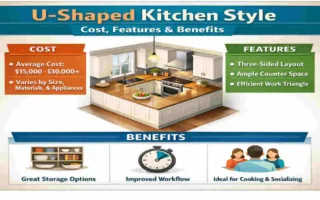
U-Shape Layout 180 – 220 sq ft Families, avid home chefs, enjoy ample counters, but ensure you have at least 4 feet of walking space in the centre.
Island-Centric 200+ sq ft Heavy entertaining, large open-concept homes. Treat the island as the social hub; add a prep sink directly into the island’s top.
Design Tips to Optimise Your Kitchen Space
Regardless of whether your home falls above or below the national average, it is entirely possible to design a space that looks beautiful and functions flawlessly. You need to apply smart design principles. Here is how you optimise your kitchen dimensions and sq ft in 2026.
Maximising Small and Average Spaces
If you are working with the national average of 161 square feet, you need to protect your walking aisles. A common design rule dictates that you need roughly 10 linear feet of countertop space to comfortably prep meals and store small appliances like coffee makers and toasters.
Furthermore, you must maintain proper clearance. If you install an island, you need at least 42 inches (about 3.5 feet) of walking space between the island and the perimeter cabinets. If two people frequently cook at the same time, you really need 48 inches (4 feet) of aisle space to prevent bumping into each other.
In smaller spaces, multi-functional furniture saves the day. Consider a rolling butcher block cart that acts as an island when you are chopping vegetables, but can be pushed against the wall when you need floor space for a party.
Embracing Design Trends
Technology and modern engineering are making it easier to do more with less space. As we navigate 2026, smart appliances are actually shrinking their exterior footprints while maximising their interior capacity. You can now buy sleek, counter-depth refrigerators that hold just as much food as the bulky, space-hogging models of the past.
We are also seeing a massive rise in sustainable modular designs. Homeowners are choosing modular cabinet systems that can be easily reconfigured as their lifestyles change, rather than tearing down and rebuilding custom millwork.
Budgeting for Your Size
Obviously, the size of your room directly impacts the cost of a remodel. You pay for flooring, countertops, and cabinetry by the square foot. Here is a rough look at how the size of your project impacts a modern 2026 renovation budget:
Kitchen Size Estimate Remodel Budget Range (Mid-Tier Finishes)
Small (120 sq ft) $15,000 – $25,000
Average (161 sq ft) $25,000 – $40,000
Large (200+ sq ft) $45,000 – $70,000+
Common Mistakes to Avoid
The most frequent mistake homeowners make when remodelling an average-sized space is overlooking the traffic flow.
Do not place your refrigerator right next to the room’s main entrance. Every time someone opens the fridge door to grab a drink, they will block the entire walkway. Similarly, do not force an island into a 140-square-foot room just because you saw it on a home improvement show. If the island restricts your walking aisles to less than three feet, the room will feel stressful and claustrophobic. Sometimes, a beautiful L-shaped open-concept layout without an island is the much smarter choice.
Kitchen Size and Home Value Impact
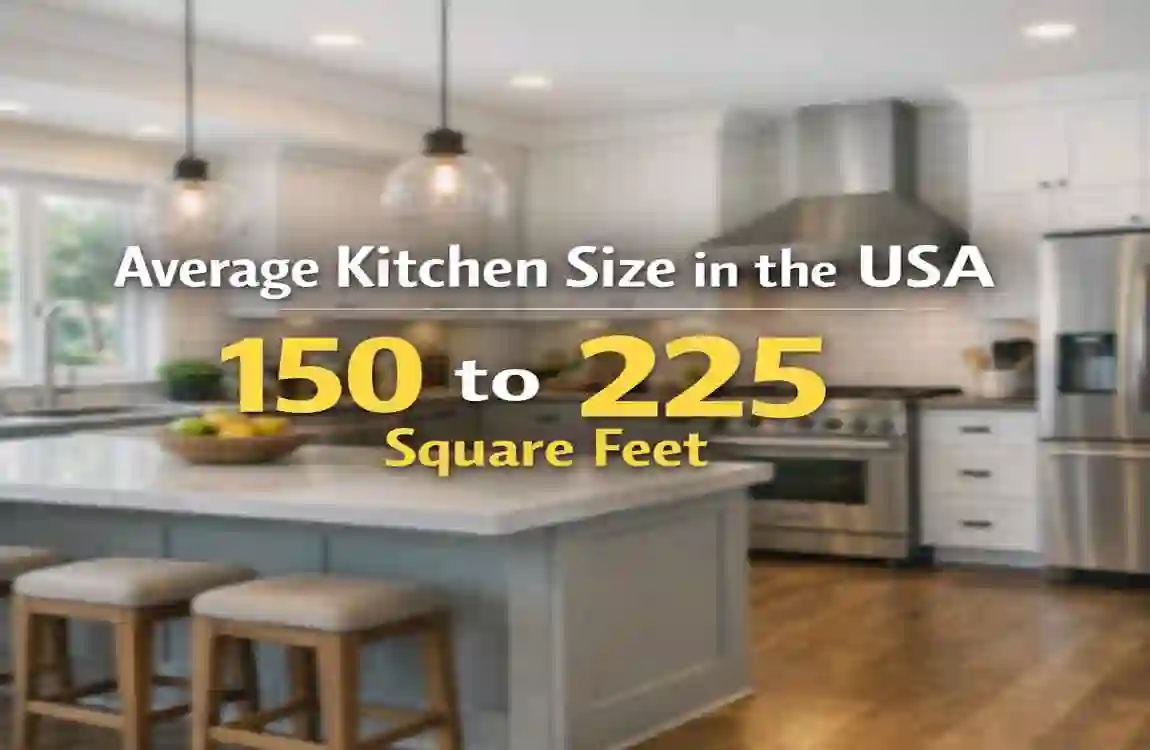
Finally, let us talk about your return on investment (ROI). When you ask, ” How big is the average kitchen in square feet in the USA, you are not just asking about cooking; you are asking about real estate value.
The kitchen is universally known as the room that sells the house. When prospective buyers walk through your front door, they will immediately judge the size, flow, and finish of your cooking space.
The ROI of a Larger Kitchen
Data consistently shows that larger kitchens (pushing into the 200+ square foot range) actively boost the overall resale value of a standard suburban home by 7% to 10%. Buyers in 2026 want space. They want pantries, they want islands, and they want an open flow into the living room.
In fact, recent real estate analytics reveal that listings featuring the words “spacious kitchen” or “oversized island” tend to sell up to 30% faster than those with standard or small cooking areas.
Advice for Designing Your Dream Home
However, you must exercise caution. The best advice for maximising your home’s value is to ensure the kitchen’s size aligns with the overall lifestyle and scale of the house.
You want to avoid “overbuilding” your neighbourhood. If you live in a neighbourhood of modest 1,500-square-foot homes, spending $80,000 to build a massive 300-square-foot commercial-grade cooking wing will not yield a good return on investment. The house will feel completely disproportionate, and buyers in that neighbourhood price bracket will not pay the premium.
Conversely, if you live in a luxury neighbourhood and you try to cram a tiny galley kitchen into a 4,000-square-foot house, buyers will walk away entirely. Keep your dimensions proportional to the rest of your dream home.
Frequently Asked Questions (FAQs)
When planning a massive home project, it is normal to have many quick, rapid-fire questions. Here are the most common questions homeowners ask regarding standard room dimensions.
How big is the average kitchen in square feet in the USA? The direct answer is 161 square feet for modern, newly constructed single-family homes. However, older homes or homes in dense urban environments often average closer to 120 to 150 square feet.
What’s the smallest functional kitchen size? A highly functional, tightly designed cooking space can operate beautifully in as little as 70 to 80 square feet. You see this frequently in historic city apartments or tiny homes, requiring very clever vertical storage and scaled-down appliances.
How many square feet do I need for an island kitchen? To comfortably fit a standard island and maintain safe, walkable aisles, you generally need at least 150 square feet. Anything smaller than this will result in tight, frustrating walkways.
Are there major size differences by state? Yes, absolutely. States with sprawling suburban land (like Texas and California) boast averages pushing over 200 square feet. In contrast, densely populated historic states (like New York and Massachusetts) see averages closer to 130 to 150 square feet.
What are the best renovation tips for small kitchens? If you are working with limited square footage, keep your colour palette light to reflect natural light, extend your upper cabinets to the ceiling to maximise storage, and invest in a deep, single-basin sink instead of a double-basin to save valuable counter space.